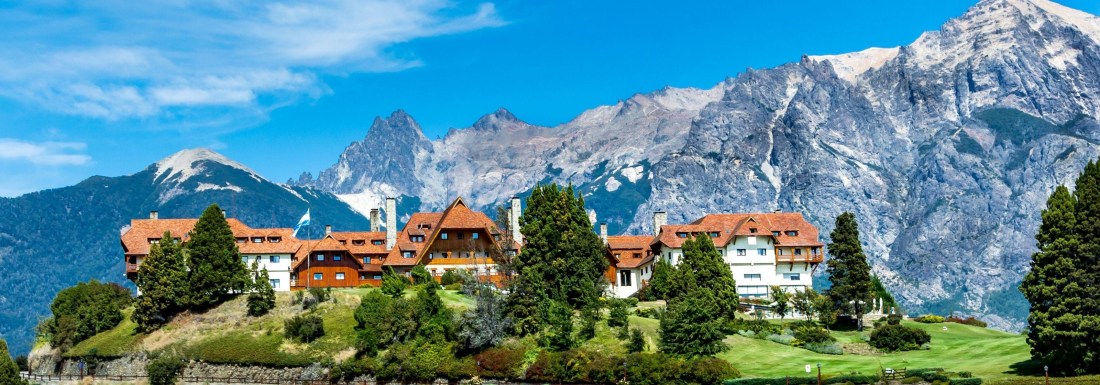
As a child, I summered in the mountains,
Beside the rocky shores of Nahuel Huapi,
In the thundering shadow of Mt. Tronador.
I knew the names of the peaks like friends
When crossing the Andes to Puerto Montt,
Where centolla crabs the size of dishes
Crawled to the table steamed and dipped in butter.
I grew up with pine cones and rhubarb,
Rocks like houses and the scent of firs,
Chased chickens and ducks round the yard,
And in the evenings, after feasting on asado,
I picked raspberries and blackberries
Behind the chalet and drizzled them with
Dulce de leche or honey from the hive.
I remember dining en famille with a wood fire
Crackling in the hearth, breathing warmth
To the evening chill descending with the night,
The wind from the lake creaking through the logs.
Above the lacquered larch wood table a goatskin
Splayed out limbs akimbo across the knotted wall,
While a wild boar‘s head with long tusks grinned.
I wandered in the shaded orchard looking
For plums and apricots fallen to the ground.
With the wind soughing through the poplars,
Swaying in parallel rows from lake to summit,
Like fingers stroking through a pony’s mane,
I lay in the grass and pictured cherubs on clouds.
And remembered the halos of the saints at church.
I loved to explore the bluff behind the house
With my dog Bobby chasing hares in the dust,
And marvel at the expanse of the lake below me,
And the darkness of the woods right behind me,
And the silence of the pines muffling my breath;
And whenever I was lost I would call out to Bobby,
And he would lead me to the peones drinking mate.
I collected llao-llao knots and amancay flowers,
Rooted out mushrooms from under pine needles,
And gathered pumice stones along the beach.
One summer we arrived to find the sapphire lake
Painted emerald with an eruption of volcanic ash.
That year, while moored at the harbor, an earthquake
Swallowed the steamboat that ferried tourists to the fjords.
I remember the wind whipping up white caps
Like lamb’s wool shorn at the shearing camp
Where the Limay leaves the lake for the Rio Negro,
Where Prince Philip called a gaucho, “Duke Jones,”
Where oligarchs on horse hunted puma and jabali,
Where above the estancia, twin peaks like breasts
Echoed tales of Nazis hiding from hunters of justice.
I loved to ride in the back seat of the old black Ford
Upholstered with felt, smelling of memories and oil,
And dig out hot dough from the crispy bread crust.
When we shopped at the butcher’s I held my mother’s hand,
At the grocer’s I smelled the raw potatoes still covered with dirt,
Leaving town, I heard the bells of the Centro Civico peal out noon
As the Indian, the soldier, the farmer, and the priest came out to play.
I squirmed excitedly before our last stop at the Correo Central,
The green gray stones and log framed windows like a fairy tale;
Where Swiss men in leather met Chilean women in ponchos,
Where Germans on the gringo trail slung heavy backpacks
To the floor, and shambled to the postbox to drop off mail;
While a drumbeat of seals stamped on envelopes echoed
Around the bare room like gunshots in a Western saloon.
Much later, I strolled the streets of breezy Bariloche,
Where military caudillos and Montonero guerrillas
Shopped together for Swiss clocks and chocolates,
And posed for pictures with a drowsy St. Bernard
Panting in the town square, beneath General Roca
Astride a tired horse, leading the Conquest of the Desert
From the pampas to Patagonia to pacify the Mapuche tribes.
Translations
Centolla – southern king crabs (lithodes santolla) fished in the southern Atlantic and Pacific Oceans.
Asado – meat grilled on a wood fire, including beef, lamb, goat, and pork, sausages, sweetmeats, and other delicacies
Dulce de leche – a delicious confection of caramelized milk. Peon – a field hand, day laborer, handyman helping with chores.
Mate – a herbal (ilex paraguariensis) drink rich in vitamins steeped in hot (or cold) water and sipped from a gourd called a mate through a silver straw called a bombilla.
Llao-llao – a species of spongy fungus (cyttaria hariotii) that grows on Southern beech trees (coihue, ñirei, and lenga from the nothofagus family) and causes large canker knots crafted into artifacts for the tourist trade. Llao-llao means “delicious and sweet” in the indigenous language of Patagonia and is sometimes called “Indian bread.”
Amancay – a species of southern lily (alstroemeria aurea) with yellow flowers, common to Patagonia and the Andes, and a symbol of unconditional love.
Gaucho – a cowboy from Argentina, Uruguay, Paraguay, and southern Brazil, skilled in horsemanship and cattle herding.
Puma – Spanish for a mountain lion.
Jabali – Spanish for a wild boar.
Estancia – Spanish for a large ranch.
Centro Civico – the Civic Center of San Carlos de Bariloche was built in 1939 and opened in 1940. Designed by architect Ernesto de Estrada, it was built from green-grey tuff stone, slate, and Fitzroy cypress (larch/alerce), and included the Domingo Sarmiento Library, the Francisco Moreno Museum of Patagonia, the City Hall, the Post Office, the Police Station, and the Customs House. At the strike of noon, the City Hall clock tower revolved figures of an Indian, a soldier, a farmer, and a priest, representing the first inhabitants of Patagonia. A statue of General Julio Argentino Roca, twice president of Argentina, was erected in the middle of the Civic Center plaza looking out towards Lake Nahuel Huapi. His effigy was spray painted red by members of the Mapuche tribe whose ancestors were massacred by General Roca. The pavement of the plaza now features the names of those who disappeared in the Dirty War following the military coup that deposed Isabel Peron in 1976.
Ponchos – A wool, cotton, or linen cloth with a neck slit cut in the middle and draped over the shoulders.
Gringo – a pejorative term for an American or European foreigner.
Caudillo – a military and political leader in Spain and Spanish America with dictatorial powers and a cult of personality among followers.
Montonero – a left wing, urban Peronist rebel group who fought an insurrection against the Argentine government in the 1970s, killing and kidnapping many officials, military, and wealthy businessmen. They were exterminated by the military junta during the Argentine Dirty War that saw 10,000 people disappear extra-judiciously.
Pampas – the fertile grassland plains of central Argentina bounded by Patagonia to the south, the Gran Chaco to the north, the Andes to the west, the River Plate to the east, and extending across Uruguay to southern Brazil.
Mapuche – an indigenous tribe of southern Chile and Argentina, brutalized by General Julio Argentino Roca during the Campaign of the Desert (1878-1884).
 songsofaglobalnomad.com